
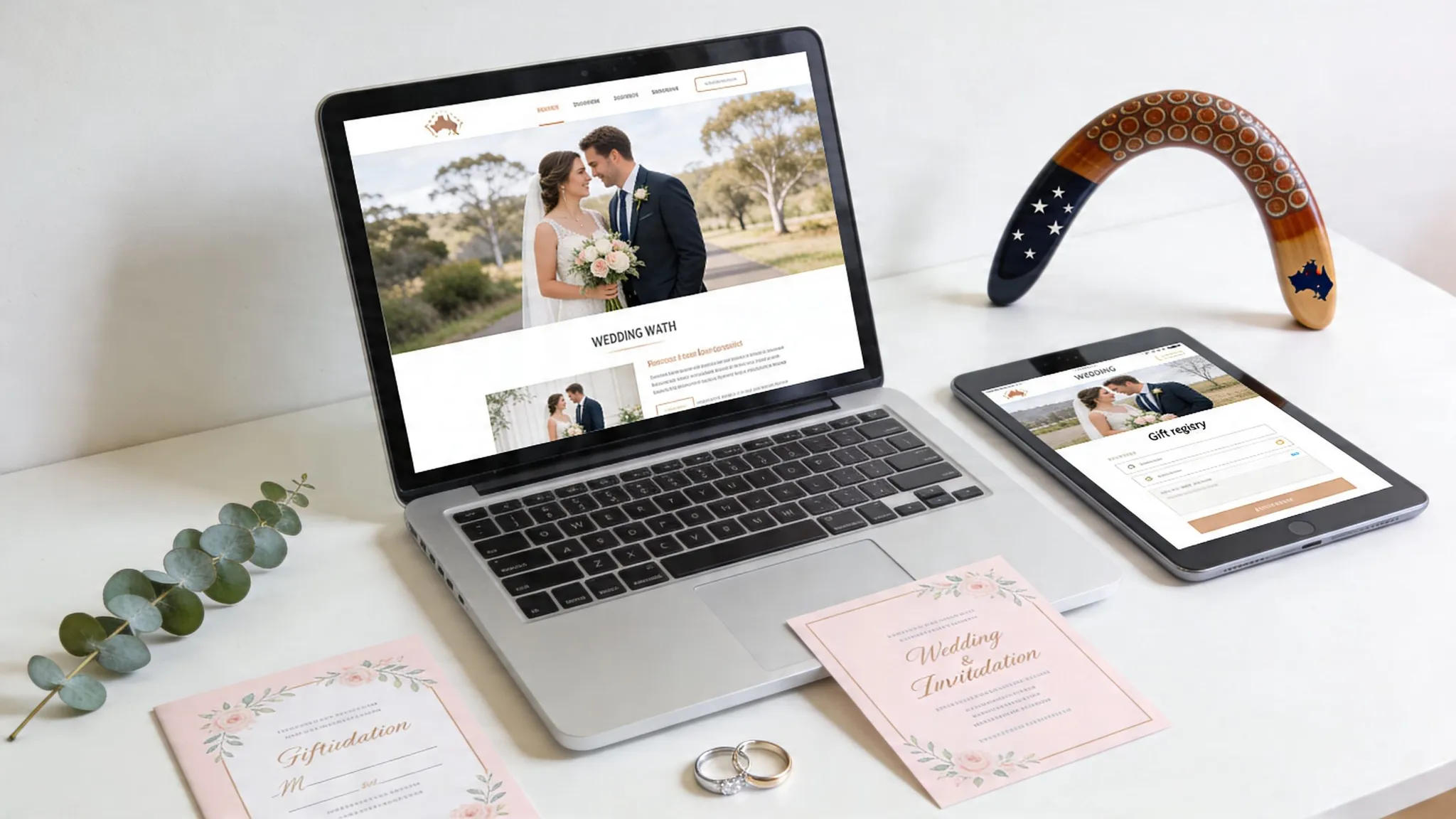
You’re engaged, excited, and probably already drowning in tabs.
One tab has dresses. Another has venues. Another has wedding websites with names that sound polished, easy, and all-inclusive. Then you hit the registry question and things get messy fast. The site looks beautiful, the templates are slick, the RSVP tool seems simple, but you’re left wondering whether a US platform functions the way an Australian couple needs it to.
That’s the key decision. Not “which website looks nicest?” but “which setup will make planning easier for us and gifting easier for our guests?”
A lot of couples start with the with joy wedding website because it’s free, modern, and fast to set up. That makes sense. It’s a strong product. But if your registry matters, especially if you want cash funds, Australian retailers, and fewer payment headaches, you need to look past the homepage.
Before you lock anything in, it also helps to sort the bigger planning decisions that shape what your website needs to do. If you’re still narrowing down location, this guide on how to choose a wedding venue is worth reading because venue style, travel logistics, and guest count all affect how you use your website and registry.
Your Wedding Planning Journey Begins
Most Australian couples start in the same place. You get engaged, send a few screenshots to friends, and then decide to “just set up a wedding website tonight”. A few hours later, you’re comparing platforms from overseas, trying to work out whether one tool can handle invitations, RSVPs, guest questions, gift lists, and honeymoon contributions without creating extra work.
That confusion is normal.
The website side is usually the easy part. You pick a design, upload a photo, add your story, and suddenly it feels real. The registry side is where the shine wears off. A platform can look polished and still be awkward for Australian bank transfers, local shopping preferences, and guests who’d rather buy from familiar retailers than deal with an imported system.
I see couples fall into two camps.
Some want one tool for everything, even if it means compromise. Others care less about the “all-in-one” promise and more about getting the registry right the first time. Neither approach is wrong. But they lead to very different outcomes.
The hard part is that global platforms market convenience. Local needs don’t always show up clearly until you’re already deep into setup. By then, changing course feels annoying, so couples often stick with a system that isn’t the best fit.
That’s avoidable. You just need to separate two decisions that often get lumped together: your wedding website and your registry experience. Once you do that, the trade-offs become much easier to judge.
Understanding The With Joy Wedding Website Platform
If you’re considering the with joy wedding website, start with what it does well. It’s a free wedding website builder built around the idea of keeping your wedding details, guest communication, and registry tools in one place.
According to Semrush traffic data for withjoy.com, WithJoy launched in 2016 and recorded 6.46 million visits worldwide in September 2025, with over 600 templates, a 100% free core platform, and over 1 million registries globally by 2025 estimates, with Australia representing 5-7% of its user base. That tells you two things. First, this isn’t a niche tool. Second, plenty of Australian couples are already using it.
Why couples like it
The appeal is obvious.
You can create a site quickly, choose from a large design library, add your schedule, travel details, Q&A, wedding party info, and collect RSVPs without paying for the basics. For couples who want a clean digital home for the wedding, that’s a strong offer.

It also helps that Joy understands a modern guest journey. Guests expect to check details on their phone, revisit the schedule, and look up addresses without messaging you at 10.30 pm. Joy is built for that kind of behaviour.
If guest photo collection matters to you, it’s also smart to compare dedicated wedding photo sharing features so you know whether the built-in tools are enough or whether you’ll want a separate photo-sharing setup after the event.
What the platform is strongest at
Joy’s strongest feature isn’t the registry. It’s the combination of design plus guest administration.
The website builder gives you broad visual choice. You won’t get endless developer-level control, but you will get enough variety to make the site feel like your wedding rather than a generic event page. That’s the difference many couples care about.
The practical side is strong too. You can organise key pages such as:
- Home and welcome message for your main event details
- Schedule so guests stop asking what time the ceremony starts
- Travel information for accommodation and transport notes
- Q&A pages for dress code, kids, parking, and timing
- Registry access if you want gifting linked into the same ecosystem
A wedding website works best when it reduces guest questions, not when it gives you one more thing to manage.
The main catch
Joy is best viewed as a website-first platform. That’s not a criticism. It’s the right way to judge it.
If your top priority is a polished, free, easy-to-launch wedding website, Joy is one of the strongest options in the market. If your top priority is an Australian-friendly registry setup, especially for cash gifts and local shopping behaviour, you need to test that part much more carefully before committing.
That distinction matters because a website can be globally elegant while the financial mechanics behind the registry still feel foreign to local users.
The Australian Registry Dilemma All-in-One vs Specialist
Many couples often make the wrong call.
They assume the best wedding website must also be the best registry. It often isn’t.
For Australian couples, the registry isn’t a side feature. It’s a practical system that has to work for real guests using local cards, local stores, and local expectations around gifting. According to WithJoy’s wedding website page, 68% of Australian couples prefer cash contributions for honeymoons or home deposits, while many US-based platforms lack native support for AUD transfers without foreign exchange fees averaging 2.5-4%, can’t integrate with local retailers like Myer or David Jones, and create frustration for 42% of couples.
That changes the conversation immediately.
Why the all-in-one pitch breaks down
An all-in-one platform sounds efficient. One login. One design system. One link to send guests.
But convenience on the front end can hide friction on the back end. The problem isn’t whether a US platform “has a registry”. The problem is whether that registry fits how Australian weddings work.
A lot of local couples don’t want a traditional gift list full of imported products. They want contributions toward a honeymoon, a home deposit, or a flexible mix of cash and chosen gifts. They also want guests to feel comfortable using the registry without second-guessing payment methods or wondering why common Australian retailers aren’t part of the process.
The three pressure points
Here’s where the mismatch usually appears:
| Decision area | All-in-one US platform | Specialist local registry |
|---|---|---|
| Cash gifting | Can be convenient in theory, but may create currency and transfer issues | Usually built around local payment expectations |
| Retail choice | May favour overseas systems and retailer networks | Usually aligns better with Australian shopping habits |
| Guest comfort | Looks polished, but some guests may hesitate at unfamiliar flow | Often feels more straightforward for local guests |
One practical checkpoint is whether the registry structure suits your priorities before you get emotionally attached to the website design. If pricing and setup are part of that evaluation, review the local registry model directly at https://www.easyregistry.com.au/pricing.
What matters more than “integration”
Couples often overvalue native integration and undervalue guest behaviour.
If the website and registry sit inside one branded platform but your guests find the gifting process awkward, you haven’t simplified anything. You’ve just centralised the inconvenience.
Practical rule: Judge a registry by the guest’s experience and the money flow, not by how neatly it sits inside your wedding website dashboard.
The registry should answer simple questions cleanly:
- Can guests give in a way that feels familiar?
- Can you receive contributions without unnecessary financial friction?
- Can you include the shops or gift types you want?
- Can older relatives use it without ringing you for help?
If the answer to those questions is shaky, the registry isn’t good enough, even if the website is beautiful.
The mistake I’d avoid
Don’t choose a registry because the website builder impressed you.
Choose your registry based on how Australians give wedding gifts. Then decide whether the website platform supports that plan well enough, or whether you should split the functions and use the best tool for each job.
That’s the smarter move for most couples. Not the most marketed move. The smarter one.
Feature Comparison With Joy vs EasyRegistry
Here’s the blunt version. With Joy is stronger as a wedding website and guest communication hub. A local registry service is stronger where gifting gets financially and logistically specific for Australian couples.
That doesn’t mean one replaces the other. It means they solve different problems.
| Feature area | With Joy | EasyRegistry |
|---|---|---|
| Website design | Strong template-led website builder | Not the main reason couples use it |
| Guest management | Strong RSVP and event information tools | Not positioned as a full wedding website hub |
| Cash funds for AU couples | Needs careful scrutiny for local suitability | Better suited to local cash fund expectations |
| Local registry fit | Can feel US-centric in setup and retailer logic | Better aligned to Australian use cases |
| Best use case | Couples who want a free, polished website | Couples who want gifting to work smoothly in Australia |

Website builder and wedding presentation
This is Joy’s home turf.
According to Joy 101 in the WithJoy Help Centre, Joy offers robust guest management for 300+ attendees, free online RSVPs with meal tracking, guest segmentation labels, and a native mobile app. The same source notes that Joy’s 600+ templates offer broad design choice, while customisation is more limited than platforms with full CSS access.
That’s a fair summary of the product. It’s visually strong, fast for non-technical couples, and useful when you have a lot of information to organise.
Where Joy wins
- Template depth: You have plenty of design directions without needing to build from scratch.
- Guest list control: RSVP tracking, labels, and event segmentation make a big difference once invitations go out.
- Mobile communication: The app supports updates and guest-facing convenience.
- Low entry cost: Core features are free, which matters when your wedding budget is already stretched.
If your site needs to handle schedule changes, travel details, meal choices, and private event segmentation, Joy is built for exactly that.
Where Joy is less flexible
The customisation ceiling is lower than it first appears. For most couples that won’t matter. For design-heavy couples, it might.
If you want highly bespoke branding, layout control, or full visual freedom, Joy can feel template-bound. The issue isn’t that the templates are weak. It’s that you’re still working inside a system designed for speed and consistency, not creative control at any cost.
Registry flexibility and local relevance
Now, the comparison shifts.
A dedicated registry tool isn’t trying to be your wedding website, your guest messaging centre, and your event planner in one. That narrower focus is exactly why it can work better for gifting.
With a local registry service, the usual advantage is fit. The system is built around how Australian couples and guests behave, not around a US default that happens to be available globally.
The best registry isn’t the one with the neatest dashboard. It’s the one your guests can use without confusion and you can receive from without friction.
If gifting is a central part of your setup, look closely at what a registry-first platform prioritises. A local example is https://www.easyregistry.com.au/features, which shows the sort of functionality couples often want when gifts and cash contributions need to be handled clearly.
Cash and honeymoon funds
This is the deciding factor for a lot of couples.
Website platforms often make cash funds look simple. They add a honeymoon tile, a home deposit tile, maybe a few styled sections, and the interface looks complete. But a deeper question is what happens underneath that design.
With Joy approach
Joy offers a registry layer inside the wider platform, which is convenient if you want everything housed together. For some couples, that’s enough.
But Australian couples need to ask harder questions:
- Is the fund process intuitive for guests paying from Australia?
- Does the setup feel local in language and expectations?
- Are there avoidable conversion or transfer issues?
- Will you need workarounds for the type of gifting you want?
Local registry approach
A specialist local service is usually more practical when cash gifting is central to the plan. Honeymoon funds and home deposit contributions are not edge cases in Australia. They’re mainstream preferences. A registry built around that reality tends to feel more natural from setup to payout.
What to prioritise: If your registry is mostly cash gifts, treat payment handling as the main feature, not a side note.
That’s the point many couples miss. They spend time choosing fonts and almost none checking how the cash side functions.
Guest experience from invitation to gift
Guest experience is where these two tools can complement each other rather than compete.
Joy is strong at getting guests to the right information. It can act as the central wedding hub where people find dates, addresses, schedules, and RSVP forms. That’s useful because guests already expect a website.
A dedicated registry can then do the job the website doesn’t handle as well. It becomes the gifting destination, while the website remains the communication centre.
If you use only Joy
This is simplest on paper. One platform. One flow. Less setup.
But “simplest” only stays true if your registry needs are basic and your guests won’t hit any local friction.
If you separate the tools
This takes a bit more planning upfront. But the logic is stronger:
- Use Joy for website, pages, event details, and RSVP handling.
- Use a local registry for gifts and contributions.
- Link them cleanly so guests move from one to the other without confusion.
That hybrid setup often gives couples the cleanest outcome because each part of the wedding planning system is handled by the tool best suited to it.
My recommendation on features
If you’re choosing between these platforms as if one must do everything, you’re framing the decision badly.
Choose With Joy if your first priority is a free, polished wedding website with strong RSVP and guest management.
Choose a local registry service if your first priority is practical gifting for Australian guests.
Choose both together if you want the strongest overall setup.
That last option is the one I’d recommend to most Australian couples because it avoids the biggest compromise. You don’t have to sacrifice website quality to get a better registry experience.
Real-World Scenarios Which Tool Suits Your Wedding Style
The right setup depends less on features and more on what kind of couple you are when planning gets real.
Some couples care most about presentation. Some care most about simplicity. Some want the whole system to feel elegant to guests from the first click to the final gift. These couples shouldn’t all make the same decision.
The design-focused couple
You care about aesthetics first. You want a beautiful site, organised pages, a clean mobile experience, and a wedding hub that feels considered.
You’re probably the couple who notices typography, photo cropping, and whether the travel section feels clunky. You want your site to look polished without spending weeks building it.
For you, the with joy wedding website is a strong fit on the website side. The template range is broad enough that you can get a look that suits a city celebration, a coastal wedding, or something more classic without touching code.
Your weak spot is assuming the registry should stay in the same ecosystem just because the site looks good. Don’t make that leap automatically. Design quality doesn’t solve local gifting issues.
The practical planners
You don’t care whether your wedding website is the most visually impressive one your friends have seen. You care whether guests can RSVP properly, find the venue, and give a gift without hassle.
You’re usually planning with a spreadsheet open. You want fewer moving parts and fewer awkward messages from relatives asking how the gift contribution works.
For you, the registry decision should lead. If cash gifts, honeymoon contributions, or local store flexibility matter most, build around that need first. Then choose a website that communicates clearly.
If gifting logistics are a major concern, the “best” wedding website is the one that stays out of the way of a better registry setup.
That often means using a strong website tool for guest information and a separate local registry tool for gifts.
The hybrid couple
This is the group I see most often. You want a stylish website, but you’re also realistic. You don’t want overseas friction built into something as basic as receiving gifts from Australian guests.
You’re not interested in ideological purity about “all-in-one”. You just want a system that works.
That’s why the hybrid model makes sense. It lets you keep a polished wedding website while avoiding the registry compromises that can come with a US-first platform.
This setup works especially well if:
- You want a proper wedding website with schedule, travel, and RSVP tools
- You expect cash gifts rather than a traditional department-store list
- Your guests include a mix of ages, with different comfort levels online
- You don’t want to rebuild your website later because the registry part didn’t suit
The couple who should use one tool only
There is still a case for using just one platform.
If your registry is very simple, your guests are digitally comfortable, and you value convenience over local specialisation, using Joy alone can be perfectly reasonable. Not every wedding needs a layered setup.
But if you already know your guests will want local familiarity, or you know your gifting plan centres on contributions rather than standard products, using one global tool for everything is usually the wrong compromise.
The best fit in plain English
If your wedding website is the star, Joy makes sense.
If your registry needs are the star, local wins.
If both matter, stop trying to force one product to do two jobs equally well. Use the polished website where it excels and use the specialist registry where it makes life easier.
That’s not overcomplicating your planning. It’s avoiding avoidable friction.
How to Combine a With Joy Website and EasyRegistry
This is the setup I’d give most Australian couples because it keeps the best part of each tool and drops the weakest compromise.
Use With Joy as your wedding website and guest communication hub. Use a local registry as the gifting destination. Then connect them cleanly so guests never feel like they’re being bounced around randomly.
The website stays elegant. The registry stays practical.

Step one build your Joy website first
Start with the site structure.
Create your main pages in Joy: welcome page, schedule, travel, Q&A, and RSVP flow. Don’t overwork the copy. Guests want clarity more than poetry.
Keep the navigation simple. If the site is clean, guests will trust the next click.
Step two create your registry separately
Set up your registry on the local platform you intend to use. Make sure the link is final before you place it on your website.
If you want to see how that process generally works on the registry side, review the setup flow at https://www.easyregistry.com.au/how-it-works.
The key is consistency. Don’t test three registry ideas and leave old links floating around. Finalise one and commit.
Step three add a dedicated registry page in Joy
Inside your Joy website, create a registry page or edit the existing registry section so it clearly explains what guests should do.
Use direct wording. Something simple works best:
- We’ve created our gift registry here.
- If you’d like to contribute to our honeymoon or choose a gift, please use the link below.
- Thank you for celebrating with us.
You don’t need a long explanation. Guests only need confidence that they’re in the right place.
Best practice: Treat the registry page like a signpost. Short text, clear button, no clutter.
A quick walkthrough can help if you want to see how Joy pages are managed in practice.
<iframe src="https://www.youtube.com/embed/01jDjC1nE88" allow="accelerometer; autoplay; clipboard-write; encrypted-media; gyroscope; picture-in-picture" allowfullscreen></iframe>
Step four make the link obvious
Don’t bury the registry under extra clicks.
Add the registry to your main menu if possible. If not, place it prominently in the welcome text or navigation flow. Guests shouldn’t have to hunt for it.
Good placements include:
- Top navigation if your template supports it
- Homepage button near the main wedding details
- Q&A mention if guests may ask about gifts
- Digital invites or email communications that point back to the website
Step five test it like a guest
Open the site on your phone. Then send the registry link to a friend or family member and ask one question: “Was any part of that confusing?”
That test matters more than your own opinion because you already know how the system works. Your guests don’t.
If they can move from website to registry without hesitation, you’ve built the right setup.
Final Verdict for Your Australian Wedding in 2026
If you want a clean answer, here it is.
With Joy is a very good wedding website platform. It’s popular for a reason. The design options are strong, the guest management tools are useful, and the free entry point makes it easy to recommend for couples who want a polished digital home for their wedding.
But that doesn’t automatically make it the best registry solution for Australian couples.
If your registry is a minor detail and you mainly want a beautiful site with built-in convenience, using the with joy wedding website on its own may be enough. Keep it simple and move on.
If your registry matters, and for most couples it does, especially when cash gifts and local shopping behaviour are involved, I wouldn’t rely on a US-first all-in-one platform without questioning the fit. That’s where the cracks usually show.
My advice is straightforward. Use Joy for what it does best: website, RSVP, guest communication, and event presentation. Use a dedicated local registry service for what it does best: gifts, contributions, and an Australian-friendly experience.
That hybrid setup is the strongest option for most Australian weddings in 2026 because it gives you the part guests see and the part guests use without forcing one platform to be perfect at both.
If you want a registry that’s built for Australian gifting habits rather than adapted from an overseas default, have a look at EasyRegistry. It’s a practical option for couples who want one shareable registry link, flexible gift and cash fund setup, and a smoother experience for local guests.