
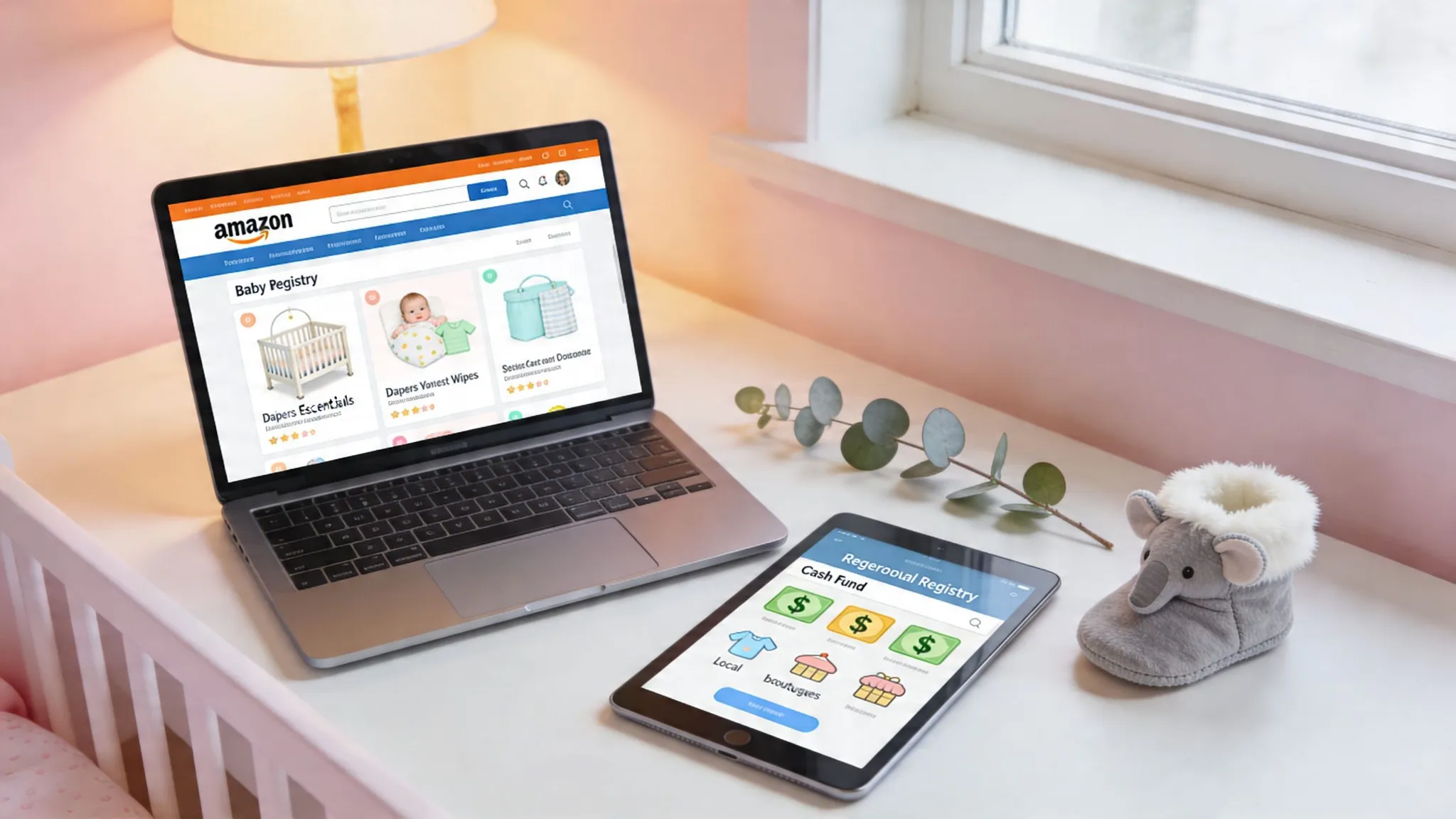
The most popular advice on the amazon baby registry is too simplistic for Australian families. It usually goes like this: Amazon is massive, easy, and packed with perks, so just use that and move on.
I don’t agree.
If you’re in Australia, your registry isn’t just a cute wishlist for baby showers. It’s a planning tool for avoiding duplicate gifts, covering expensive essentials, handling family expectations, and making sure people can buy what you’ve asked for without getting confused. A registry that works beautifully in the US can feel clunky, expensive, or oddly limited here.
That matters more than people admit. New parents don’t need more friction. They need fewer random soft toys, fewer duplicate swaddles, fewer guest questions, and a clearer path to getting the pram, cot, monitor, nappies, and practical support they’ll use.
Why Your Baby Registry Choice Matters More Than You Think
A bad registry creates work for you. A good one removes it.
That’s the part most guides miss. They treat a baby registry like a shopping list with a bow on top. In real life, it’s a small logistics system. It decides whether your guests can contribute easily, whether your family buys the right things, and whether you end up with support that suits how Australians give gifts.

A lot of first-time parents start with brand recognition. They see Amazon, assume it’s the safe option, and don’t stop to ask better questions. Can Nan buy from it without getting lost? Can your mates chip in for a bigger item? Can people give cash for the things you’ll sort out later? Can you include items from local shops you already trust?
Those questions matter because baby gear isn’t one neat category. You’ve got bulky essentials, safety-sensitive items, local brands, second-stage purchases, and things people want to fund rather than physically wrap. If your registry can’t handle that mix, you’ll feel it quickly.
What a registry should actually do
A registry worth using should help with three things:
- Gift coordination: stop duplicate presents and make it obvious what’s already covered
- Real-life flexibility: support products, contributions, and different buying preferences
- Less admin: keep you out of endless text threads answering “what do you still need?”
If your partner is still adjusting to the whole pregnancy planning side of things, this practical guide for dads-to-be is worth sending over. It’s useful because registry decisions usually sit inside a much bigger pile of mental load.
Your registry choice affects money, convenience, and guest experience. It’s not a minor decision.
Understanding the Amazon Baby Registry in Australia
Amazon does have real strengths. That’s why so many parents look at it first.
The biggest draw is obvious. Amazon already sells a huge range of baby products, lots of people already have accounts, and the interface feels familiar. If you want to set up something quickly and mostly stick to mainstream brands and online shopping, the amazon baby registry can look like the practical choice.
Early on, that convenience is hard to ignore.
The headline perks
The clearest selling point is the completion discount. In Australia, Amazon Baby Registry offers a 10% discount, or 15% for Prime members, on remaining items up to a $2,000 value. Prime members also get 365-day free returns and a welcome box with samples valued around AU$100, which gives Amazon a strong edge on raw discount and return flexibility according to this Amazon baby registry review on Baby Chick.
That’s the sort of perk that gets people in the door. If you expect to buy a lot of your remaining essentials yourself, a completion discount is appealing.
There’s also a universal-style tool. Amazon uses a Chrome extension to let you add non-Amazon items, which sounds useful if you’re browsing beyond Amazon’s own catalogue. On paper, that makes the registry feel broader than a standard single-store setup.
Why Amazon appeals to organised shoppers
If you like keeping things in one ecosystem, Amazon is tidy. You can build a registry without much fuss, keep your items in one place, and send one link around. For families already paying for Prime, the shipping and returns side can feel especially convenient.
A few parts of the setup are handy:
- Completion discount: useful if you plan to purchase leftover essentials yourself
- Long return window: helpful when you receive duplicates or change your mind after birth
- Welcome box: a nice extra if you qualify
- One familiar account: easier for regular Amazon users than learning a new platform
The practical upside in daily life
Amazon also suits a certain kind of family. If you live comfortably online, don’t care much about boutique or local retailers, and mostly want mainstream gear delivered fast, it can absolutely work.
That’s especially true if your needs are product-heavy rather than contribution-heavy. If your registry is mostly bottles, wraps, change mats, feeding gear, sleep sacks, and nursery basics, Amazon keeps things straightforward enough.
Practical rule: Amazon works best when your registry is mostly “buy this item” rather than “help us fund this stage of life”.
Comparison table
Before getting into the Australian pain points, here’s the simple version.
| Option | Best for | Main upside | Main drawback |
|---|---|---|---|
| Amazon Baby Registry | Parents buying mostly mainstream products online | Completion discount, familiar shopping flow, returns | Weak fit for local retailers, cash-style gifting, and mixed gift types |
| Australian universal-style registry | Families wanting products plus contributions and local flexibility | Broader gift formats and easier local relevance | May not have Amazon’s specific discount perks |
| Store-specific registry | Parents loyal to one retailer | Simple if most items come from one shop | Narrow product choice and less flexibility for guests |
That table sums up the trade-off. Amazon is strongest when you treat your registry as a product basket. It gets shakier when you treat it as a full gift-planning tool.
The Hidden Frustrations of Using Amazon Down Under
Here, the glossy advice falls apart.
Most write-ups about the amazon baby registry assume the US experience maps neatly onto Australia. It doesn’t. Once you move beyond the headline perks, the local gaps start showing up fast.
Cash gifts are common here, and Amazon doesn’t handle that well
Australian families often give more flexibly than overseas guides assume. A 2025 Babyology survey found that 68% of Australian baby shower gifts involve cash contributions, yet Amazon’s registry lacks native support for that. The same source notes that a 2026 Choice Australia review found only 23% of users could effectively redeem completion discounts due to stock issues with AU-compliant items, which is a serious knock against one of Amazon’s biggest selling points, as covered in this analysis of Amazon baby registry limitations for Australians.
That’s a bigger deal than it sounds.
A lot of Australian guests prefer to chip in for a pram, nursery furniture, postpartum help, or just give money towards whatever you realise you need after the baby arrives. If the platform doesn’t support that naturally, people end up asking for bank details, messaging you separately, or buying random fillers because they can’t contribute the way they wanted.
That’s not elegant. It’s messy.
“Universal” doesn’t mean seamless
Amazon’s non-Amazon item tool sounds more flexible than it really is. Yes, you can add outside items through the Chrome extension. But the guest experience is less polished than people expect, because those purchases redirect externally rather than working like one smooth checkout.
That creates friction in obvious ways:
- Guests leave the registry flow: they click out to another retailer instead of staying in one process
- Tracking gets murkier: outside purchases don’t feel as clean or unified
- Confusion increases: some guests assume every item works like a normal Amazon purchase when it doesn’t
If your registry includes local favourites or niche Australian retailers, this starts to matter quickly. The whole point of a registry is to make gifting easier, not to send guests on a scavenger hunt across tabs and websites.
If a guest has to stop and wonder, “Am I still buying this correctly?”, your registry is already doing a poor job.
Australian compliance and local stock matter more than hype
Parents here aren’t just shopping for cute stuff. They’re often looking for products that align with Australian expectations around safety, sizing, local availability, and retailer support.
That’s where the “just use Amazon” advice gets lazy. A discount is only useful if the items you need are available in forms that make sense for Australia. If stock is patchy or local-compliant options are limited, the perk isn’t as valuable as it looks in screenshots.
And then there are the hidden costs people don’t talk about enough. Cross-border quirks, delivery inconsistencies on certain products, and the general mismatch between a global catalogue and local shopping habits all make the experience less smooth than the branding suggests.
Amazon can still work, but only for a narrow use case
If you want my blunt view, Amazon is fine when your baby registry is basically a discounted shopping list for yourself with some guest purchases attached. It’s weaker when you want a registry that reflects how Australian friends and family give.
That difference matters.
Use Amazon if you’re mostly buying standard items from Amazon anyway and you’re happy to manage the rough edges. Don’t use it blindly because American articles keep calling it the default best option.
Exploring a Flexible Australian Registry Alternative
Australian parents often need something simpler in one sense and more flexible in another. Simpler for guests. More flexible for what can go on the registry.
That usually means one link, one place to browse, and room for more than just boxed products.

What Australian families usually want instead
A more flexible registry suits the reality of baby showers here. Some guests want to buy a muslin wrap or baby monitor. Others want to chip in towards a pram, a bassinet upgrade, a nappy fund, meal delivery, or a few nights of practical help after the birth.
That kind of setup works better when the registry can handle different gift types without making people jump between systems. It also helps when local retailers fit naturally into the plan instead of feeling bolted on.
A solid Australian-friendly registry should let you do things like:
- Mix products and contributions: not everything needs to be a single-item purchase
- Include local stores: handy if you prefer Australian brands or want to see products in person first
- Keep guests on one page: less confusion, fewer abandoned gift attempts
- Reflect real priorities: practical support often matters as much as nursery décor
Why local fit beats global scale
Big catalogue size sounds impressive. It isn’t always the thing that matters most.
Most families don’t need endless options. They need the right options presented clearly. For Australian parents, that can mean local furniture shops, Baby Bunting finds, boutique nursery items, or contributions towards services rather than another novelty onesie.
That’s why a flexible registry often feels less stressful in practice. It matches how people give, not just how one retailer sells.
Here’s a quick look at how a modern registry approach tends to work in practice:
<iframe src="https://www.youtube.com/embed/RWBi1pQMQEE" allow="accelerometer; autoplay; clipboard-write; encrypted-media; gyroscope; picture-in-picture" allowfullscreen></iframe>
The better question to ask
Instead of asking, “Does this registry have the biggest brand name?”, ask, “Will this make life easier for us and for the people giving gifts?”
That’s the smarter test.
If your family wants a mix of physical gifts, pooled contributions, local shopping, and fewer awkward side messages, a flexible Australian registry style usually fits better than a US-centric platform trying to stretch into universality.
Amazon vs EasyRegistry A Detailed Feature Showdown
The differences now become practical instead of theoretical.
Amazon is strong at being Amazon. That sounds obvious, but it matters. It’s a retailer first. A registry built around a retailer tends to work best when the goal is buying products from that retailer’s world. A universal registry platform is trying to solve a different problem. It’s trying to coordinate gifting across products, stores, contributions, and guest preferences.

Universal item addition
This is the category where a lot of people assume Amazon wins. It doesn’t, at least not automatically.
Amazon’s universal registry integration relies on a Chrome extension that adds non-Amazon items by redirecting purchases externally, with no consolidated checkout or tracking. That’s the limitation highlighted in this overview of registry features and universal item handling, and it’s the key distinction people miss.
A true universal approach is cleaner because it treats the registry as the central experience, not as an Amazon list with side doors.
The difference isn’t whether you can add outside items. It’s whether guests can handle those items without friction.
Winner: EasyRegistry
Group gifting and cash funds
This one is straightforward. If your registry includes larger items, pooled gifting matters. If your family prefers wishing-well style giving or practical contributions, cash support matters too.
Amazon can handle group gifting for specific items. That’s useful. But it still frames the registry around products first. That works for a cot, pram, or monitor if the item sits neatly in Amazon’s system. It’s less graceful if people want to contribute towards mixed needs or non-product support.
EasyRegistry suits broader gifting styles better because it’s built for more than single-product transactions.
Winner: EasyRegistry
Guest experience and ease of use
Guest experience is where a lot of registries ultimately succeed or fail. You might tolerate a clunky setup because you made it. Your aunt, neighbour, or colleague won’t.
Amazon has the advantage of familiarity. Plenty of guests already use it, and that lowers the learning curve. But that advantage drops the moment your registry includes non-Amazon links, off-platform purchases, or gifting methods Amazon doesn’t support well.
A unified registry page is usually easier for mixed groups of guests, especially when some are very online and some definitely are not.
For parents comparing options, it’s worth browsing the registry platform features available here and checking which setup feels clearer from the guest side, not just the host side.
Best lens: judge the platform by your least tech-savvy guest, not by yourself.
Winner: EasyRegistry for mixed guest groups. Amazon for heavy Amazon users.
Fees and hidden costs
Amazon is generally free to use as a registry, which is a legitimate strength. If your only comparison point is sign-up cost, Amazon looks great.
But “free” isn’t the whole story. Hidden cost can also mean guest confusion, less useful outside-item handling, weaker support for cash-style gifting, and registry compromises that push you into manual work later. If a platform saves money upfront but creates admin and awkward workarounds, it’s not really costless.
EasyRegistry’s value depends more on whether flexibility saves you hassle. For a lot of Australian families, it does.
Winner: Amazon on simple upfront cost. EasyRegistry on practical flexibility.
Local focus and retailer fit
The Australian angle is particularly relevant.
Amazon is an international retailer operating in Australia. That gives it scale, but not necessarily local fit. If you mainly want globally available products and standard online fulfilment, that’s fine. If you want local shops, local service habits, and gifting that reflects Australian expectations, it feels less natural.
EasyRegistry is the more local-minded option by design. That matters if you want your registry to reflect where you shop.
Winner: EasyRegistry
Privacy and customisation
Amazon covers basic registry sharing well enough. You can send the link and manage the list without much fuss. For some families, that’s enough.
But broader registry platforms generally give you more room to shape the experience around your event and your preferences. That includes how gifts are presented, how contributions are handled, and how the page feels to guests.
Amazon is functional. EasyRegistry is more adaptable.
Winner: EasyRegistry
Quick verdict table
| Category | Amazon Baby Registry | EasyRegistry | Winner |
|---|---|---|---|
| Universal item handling | Outside items added via extension, then redirected externally | Built around broader registry coordination | EasyRegistry |
| Group gifting | Works for selected items | Better suited to pooled and varied giving | EasyRegistry |
| Cash-style contributions | Limited fit | Better aligned with contribution-based gifting | EasyRegistry |
| Familiarity | Strong for regular Amazon shoppers | Clear for guests using one registry page | Depends on audience |
| Local relevance | More global than local | Better suited to Australian gifting habits | EasyRegistry |
| Upfront cost feel | Generally free | Varies by use and options | Amazon on pure simplicity |
If your registry is mostly an Amazon shopping list, Amazon makes sense. If it’s a real mix of products, stores, and contributions, EasyRegistry is the stronger tool.
Which Baby Registry Is Right for Your Family
The best choice depends less on features and more on how you want people to give.
That’s why broad “best registry” lists are usually unhelpful. They flatten everyone into one use case. Most families aren’t one use case.

Choose Amazon if your registry is mostly a shopping basket
Pick Amazon if you want the simplest version of a retailer-based registry.
This suits you if most of these sound right:
- You already buy heavily from Amazon: the account, checkout, and delivery flow feel normal
- You want mainstream products: not niche local brands or boutique retailers
- You expect to finish buying the leftover items yourself: the completion discount is part of your plan
- Your guests are comfortable shopping online: especially if they already use Amazon often
In that scenario, Amazon is a decent tool. Not perfect. Just decent and predictable.
Choose EasyRegistry if your gifting needs are mixed
Choose EasyRegistry if your ideal registry includes more than product links.
That’s the better fit if you want any of the following:
- Local retailer flexibility: you’re not building the whole list around one global store
- Contribution-style giving: guests can help with bigger priorities instead of buying fillers
- A cleaner one-link experience: especially useful for guests across different age groups
- More realistic support: products, funds, services, and practical help can sit together better
If your baby shower crowd includes grandparents, work friends, close mates, and extended family, this kind of flexibility tends to make life easier for everyone.
For families with interstate or overseas guests
This group often assumes Amazon is the automatic winner. Sometimes it is. Sometimes it isn’t.
If those guests mainly want a familiar online checkout and you’ve kept the list product-based, Amazon can be convenient. If those guests are just as happy contributing towards practical support, a flexible registry still works well and can reduce confusion because everything sits under one shareable page.
The right answer depends on what you’re asking people to give, not just where they live.
Don’t choose based on the loudest brand. Choose based on the least awkward gifting experience.
For parents trying to control costs
A lot of parents are really asking one thing: which option leaves us with fewer wasted purchases and less clean-up after the shower?
If that’s you, don’t focus only on discounts. Focus on fit.
Amazon may suit budget-conscious parents who plan to use the completion discount and keep the registry narrow. A flexible registry suits budget-conscious parents who’d rather direct generosity towards the biggest real needs instead of ending up with duplicates and side purchases.
If you’re comparing practical setup options, have a look at the registry pricing details here and weigh that against the value of having a more useful gift mix.
My blunt recommendation
Use Amazon if you want convenience inside Amazon’s world.
Use EasyRegistry if you want a registry that fits Australian giving habits better.
That’s the cleanest way to think about it. One is a strong retailer with registry features. The other is better suited to being the registry itself.
Setting Up Your Perfect Registry With Confidence
Once you’ve picked the right platform, keep the registry tight. Don’t turn it into a catalogue of every baby product you’ve seen on Instagram.
Aim for a balanced list. Include immediate essentials, a few bigger-ticket items, some lower-cost practical gifts, and room for flexible support if that suits your family. That mix gives guests options without turning the page into chaos.
A simple setup approach that works
Try this:
Start with real needs
Add feeding, sleep, travel, nappy, and bath essentials before adding aesthetic extras.Think in stages
Include what you’ll need in the early weeks, not just what looks cute before birth.Make sharing easy
Put the registry link in your invite, baby shower message, or group chat once. Don’t make people ask for it.Review it with fresh eyes
Open your own registry on your phone and pretend you’re a guest. If anything feels confusing, fix it now.
If you’re also trying to get the house and routines under control before the baby arrives, these essential first-time mom tips for a calmer, more organized home are useful alongside registry planning.
If you started on Amazon and changed your mind
Don’t panic. Plenty of parents start with one platform and realise later it doesn’t suit them.
The easiest move is to stop adding to the old registry, rebuild a cleaner version on the platform you want, and share the updated link clearly with a short note. Keep the wording simple and polite. Something like: “We’ve updated our baby registry so everything is in one place.”
If you want to see the basic flow before switching, the how registry setup works in practice page gives a useful overview.
A registry should reduce your mental load. If it’s creating more admin, change it.
The best registry is the one your guests can use easily and that leaves you with gifts you truly need. That’s the true measure.
If you want one link for gifts, cash contributions, and a smoother registry experience built for Australian families, have a look at EasyRegistry. It’s a practical option when you want more flexibility than a retailer-based registry can give.